
Zero-Click Search: What It Actually Costs You
A zero-click search is one answered directly on the results page, so nobody visits your site. It is not new — Google has done this with featured snippets and knowledge panels for years. What changed is scope: AI Overviews and AI Mode can generate a direct answer for far more queries than a snippet ever could, because summarizing doesn’t need the same structured markup a snippet extraction does.
What is zero-click search?
A search is “zero-click” when the person typing the query gets their answer without leaving the results page. That covers a few different features, not one thing:
- A featured snippet pulls a short passage from a ranking page and displays it above the normal results.
- A knowledge panel answers factual questions (a company’s founding date, a person’s age) from a structured data source, with no single page attributed.
- An AI Overview or AI Mode response generates a synthesized answer from several sources at once, usually with citations attached.
The first two have existed since 2014, when Google introduced featured snippets. What AI Overviews add is coverage: a snippet needs a page with a clean, extractable passage; a generative summary can be built from several partial sources stitched together, so it can answer a much wider range of queries the same way.
Which queries lost clicks?
Here’s where most posts on this topic overreach, and this one won’t. We do not have first-party click-through data showing which queries lost traffic to AI Overviews — no site owner does, without a controlled experiment isolating the AI Overview from every other variable that also moves rankings. Any specific percentage you’ve seen quoted for “clicks lost to AI Overviews” is somebody else’s estimate, not a number we measured, and repeating it here without a source wouldn’t meet the standard we hold our own audit reports to.
What we can point to, measured directly rather than estimated, is the scale of interest in the interfaces themselves. Per a DataForSEO capture from 31 August 2026, the term google ai mode gets searched roughly 246,000 times a month in the US and 27,100 in the UK; ai overviews gets roughly 110,000 and 14,800. Those are search volumes for the phrase, not a measurement of clicks diverted away from any particular site — they tell you how much attention the shift has, not what it costs an individual page. Treat the distinction as the point, not a footnote: conflating “people are searching about this” with “this is costing you traffic” is exactly the kind of unsourced leap this post is trying not to make.
Is a citation worth anything without a click?
Probably something, but not the same something as a visit, and the two shouldn’t be reported as interchangeable.
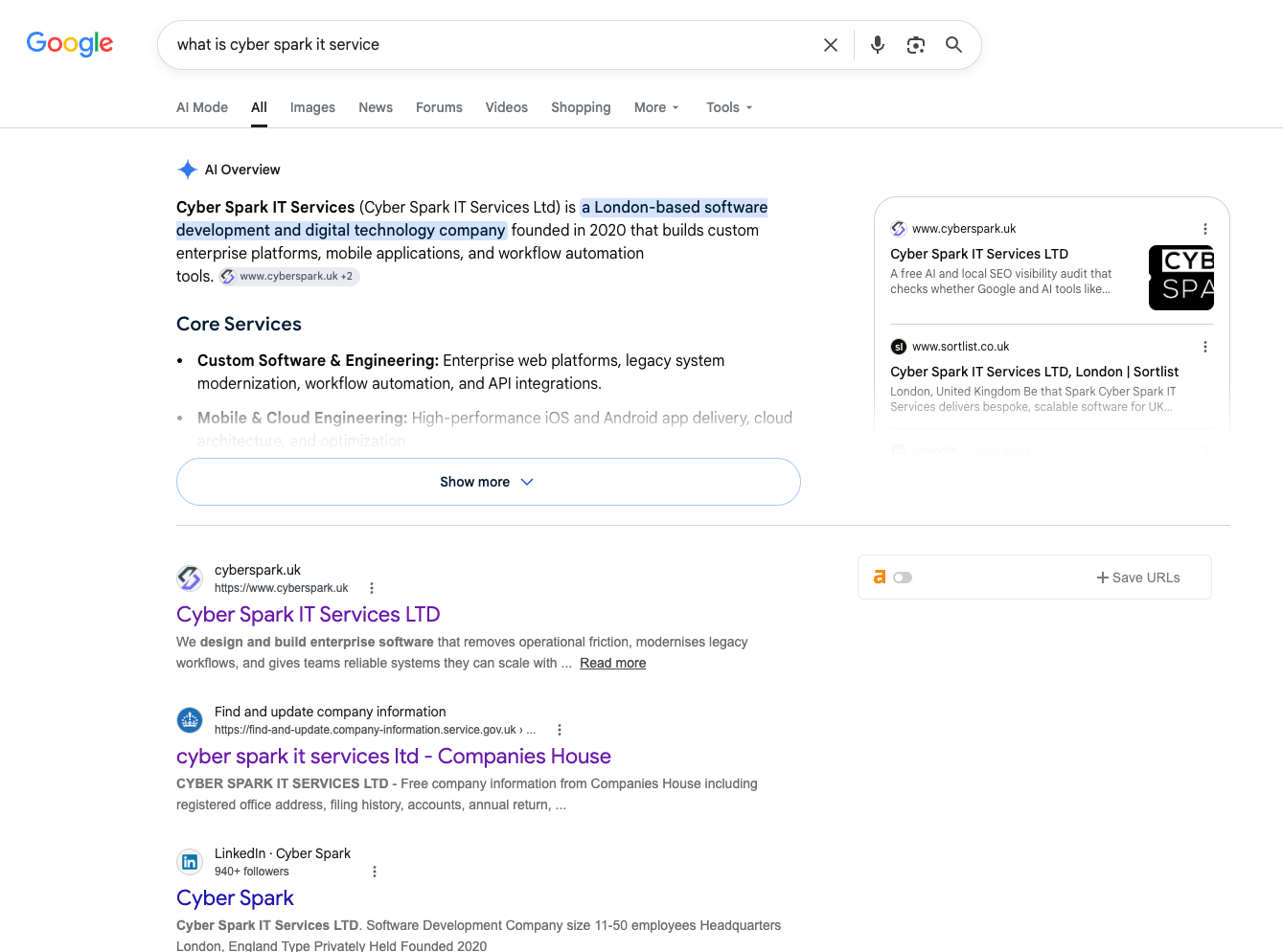
We captured a live SERP for ai visibility checker on 31 August 2026 — the exact category this product competes in. It returned only 131 total results, and Google displayed an AI Overview directly on the query. That’s a concrete, dated example of zero-click behavior landing on a term we care about: someone can get an answer to “what’s a good AI visibility checker” without clicking through to any of the 131 pages that exist to answer it, ours included.
Being one of the sources an AI Overview draws from for that query is still worth something — brand exposure, a mention next to legitimate competitors, a chance a reader remembers the name later. It is not worth the same thing a click is, and we’re not going to claim otherwise just because it’s a more flattering story for a product built around citations.
What can you still influence?
You can’t make Google stop generating direct answers. You can control three things that decide whether you’re one of the sources it draws from when it does:
- Crawler access. If GPTBot, Google-Extended, or PerplexityBot can’t reach a page, it can’t be summarized from, regardless of how good the content is. Our robots.txt checker shows what each of eighteen tracked AI crawlers is actually allowed to fetch — not just what your robots.txt claims, but whether a CDN rule silently contradicts it.
- Extractable content. A generative answer favors passages that are short, self-contained and don’t depend on surrounding context to make sense — the same shape our audit engine’s quotability checks look for. Long preambles before the actual answer make a passage harder to lift cleanly.
- Verified citation, not assumed citation. This is the one people skip. It’s easy to assume you’re being cited because your content is good; it’s different to actually check. Our free scan doesn’t test this — it covers the technical baseline only, since the free tier runs
analystOnlyand doesn’t call any AI model. The Deep Scan does run real prompts against a fixed model roster and reports whether your brand is actually mentioned or recommended, which is the only way to replace the assumption with a measurement.
How do you measure it?
Honestly, imperfectly. Comparing a query’s Search Console clicks before and after Google adds an AI Overview to it tells you something only if the query’s ranking position held steady across the same window — otherwise a click drop could be a ranking change wearing an AI Overview’s clothes. Isolating the two cleanly needs a query where you can rule out a position change, which is rarer than most write-ups on this topic admit.
The more tractable question, and the one our Deep Scan is built to answer, isn’t “how many clicks did I lose” — it’s “does the model actually mention me when asked.” That’s a yes/no you can check today, on a fixed set of prompts, dated and repeatable, rather than an estimate backed into from traffic data that has too many other things moving inside it.
Zero-click search isn’t a reason to give up on visibility — it’s a reason to measure the right thing. Run a free scan to check whether AI crawlers can reach your pages, or read the audit methodology for how each check works. For the ranking side of this same shift, see why AI search engines rank pages differently than Google.
Frequently asked questions
What is a zero-click search?
A zero-click search is one where the answer appears directly on the results page — in a featured snippet, a knowledge panel, or an AI Overview — so the person searching never needs to visit any website.
Is zero-click search new because of AI?
No. Featured snippets and knowledge panels have answered queries directly on Google's results page for over a decade. What's new is the number of queries an AI Overview or AI Mode can now cover, because generating a summary doesn't require the same structured data a snippet does.
Does being cited in an AI Overview help if nobody clicks?
It can still build awareness and trust, the same way appearing in a knowledge panel did before it. It is not the same as a visit, and treating a citation as equivalent to traffic overstates what you actually measured.
How do I know if I'm losing clicks to AI Overviews?
Reliably, you often can't, from Search Console alone. A drop in clicks after Google adds an AI Overview to a query could be that, a ranking change, or seasonal demand, and the three are hard to separate without a controlled before/after on a query that didn't also change position.
What can I still control in a zero-click environment?
Whether an AI engine's crawler can reach your pages, whether your content is written in a form that's easy to lift into an answer, and whether you can verify — rather than assume — that a specific model actually recommends you when asked.